





Spelling it out

Wyndham Lewis’ 1914 magazine Blast
The medieval dialectologist Margaret Laing was fond of a childhood spelling test: ‘A harassed pedlar met an embarrassed cobbler in a cemetery, gauging the symmetry of his uncle’s ankles and eating a desiccated pomegranate with unparalleled ecstasy.’ ‘Welcome to the world of the medieval scribe,’ she was wont to say.
Scribes, having no standardised orthography to aid them, had to rely on their own knowledge of the sounds of vowels and consonants in Latin and emerging written English, usually with overlays of accent and dialect; and they wrote what they thought they heard. Add to this the contributions of Antwerp printers, loan words, classical derivations, academic pedants, neologisms, international variations, slang and instant messaging, and you have the glorious lash-up that is English orthography today.
Attempts to bring order to the chaos began in earnest in the 1750s with Johnson’s Dictionary of the English Language, and for 150 years the Oxford English Dictionary has been charting the etymologies and usages of words. Nevertheless, even the most fluent of readers among us would not get full marks in the Laing test (be honest), which prompts the question: ‘does standardised spelling matter?’
The world of internet memes has shown us that words with jumbled letters can still be readable, as can pervasive and accidental misspellings, and eggcorns. Given that the purpose of written text is comprehension, standardised spelling may be less important than other factors, such as typography, book design and readable literary style.
There is a long history of book beautification. The illuminated manuscripts of the Middle Ages are today highly valued as art, whereas their texts may be scarcely valued at all, if we could but read them. In the 17th and 18th centuries most books were sold unbound, allowing buyers to adorn them according to taste and pocket. William Morris’s Kelmscott Press of the 1890s carefully designed and integrated text, illustration and embellishment in gothic revival style that, while a visual treat, is somewhat tiresome to read. The Golden Cockerel Press in the 1920s also took a holistic design approach, emphasising legibility and with illustrations by established artists. Eric Gill contributed wood engravings and typefaces. One of these, Perpetua, is still in widespread use today where a mark of quality and readability is required.
Design quality in publishing is parodied by Harland Miller’s subversive series Penguin Book Covers, which marries images of well-thumbed Penguin books, in their classic 1950s colour-coded house style, with his sardonic spoof titles that test the expectations of readers, such as Love Conquers Nothing; A Fist to Cry On; and Happiness, the Case Against. In his series of enormous canvases entitled Letter Paintings, shown in his recent exhibition XXX in York, Miller extends the medieval use of illuminated initial letters as art to whole words. Three- and four-letter words are piled in transparent and opaque layers to illustrate the word itself, for example the letters of YORK superimposed to create an image of a white rose.
The long list of painters projecting their philosophy into literary forms includes William Blake’s mysticism, DG Rossetti’s romanticism and Wyndham Lewis’ vorticism. An example from the era of pop art is none other than Harland Miller. Miller’s novel Slow Down Arthur, Stick to Thirty is an elegant but anarchic satire of a Bildungsroman (coming of age novel). Of necessity, much of the novel’s dialogue in the teenage argot of his native York in the 1980s is written phonetically, in the long literary tradition that stretches back to the works of George Eliot and Mark Twain. One of the novel’s themes, in artistic line with the grunge of his Penguin series, is the squalor created and tolerated by a subculture with overblown dreams, and a penchant for constant low-level substance abuse.
Personally, I am at the stickler end of the spectrum in matters of English usage. So, while I can read George Eliot’s and Harland Miller’s dialogue without distress, I really must accept that more widespread conformity is a pipe dream. As a palliative, I have ordered the desiccated pomegranate from the deli. I am looking forward to it enormously.
This article originally appeared in the Institute of Historic Building Conservation’s (IHBC’s) Context 184, published in September 2025. It was written by James Caird.
--Institute of Historic Building Conservation
Related articles on Designing Buildings Conservation.
- Architectural publishing.
- Common mistakes on building drawings.
- Common spelling mistakes in the construction industry
- Conservation area.
- Conservation.
- Getting published.
- Heritage.
- Historic environment.
- IHBC articles.
- IHBC.
- Self publishing for architects.
- Technical notes on architectural publishing.
- Writing technique.
IHBC NewsBlog
IHBC sponsors Gardens Trust event 23-4 Sept 2026
.jpeg)
'Learning from the Past, Shaping the Future’ takes place in Milton Keynes
Renovations to Frank Lloyd Wright's Fallingwater complete
.jpg)
World Heritage Preserved project opens house for tours again
Shakespeare Birthplace Trust places Hall's Croft on HAR Register
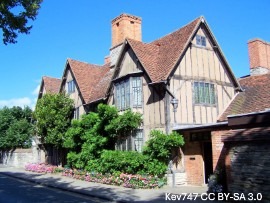
Stratford-upon-Avon home of Shakespeare's daughter is 'At Risk'
Lady Grange’s House repaired on St Kilda
.jpg)
National Trust for Scotland repairs stone cleit with link to famous island resident
Griff Rhys Jones on BBC Radio 4 Today programme
,_Green_Lane,_Derby.jpg)
The Victorian Society’s President unveiled its latest Top Ten Endangered Buildings 2026.
Need a MATE? Book your place now.
IHBC offers free webinars on applying for IHBC accreditation (Full & Associate).
UK Stained Glass Repository finds windows new homes
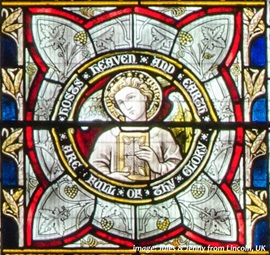
How are stained glass windows are rescued, stored and repurposed?
APPGEBE report sets high aims for quality
'Government must not sacrifice quality in drive to build 1.5m homes'
New measures protect Historic Shipwrecks from heritage crime

Underwater cultural heritage benefits from new HE guidance
How could the City of London skyline look in 6 years' time?

Visualisation shows approved planning applications as completed buildings
National Trust for Scotland calls for VAT cuts

Heritage neglect is encouraged by current policies
IHBC's 'Context' Issue 186 features Industrial Heritage
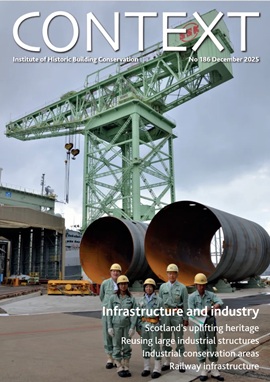
IHBC's members' journal reports on the challenges of conserving infrastructure
Book now for IHBC Annual School 2026

IHBC Annual School is taking place 18-20 June 2026 in Newcastle
RICHeS Research Infrastructure offers ‘Full Access Fund Call’
RICHeS offers a ‘Help’ webinar on 11 March
Latest IHBC Issue of Context features Roofing
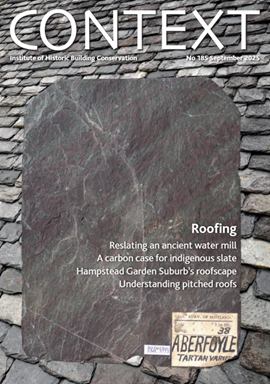
Articles range from slate to pitched roofs, and carbon impact to solar generation to roofscapes
Three reasons not to demolish Edinburgh’s Argyle House

Should 'Edinburgh's ugliest building' be saved?
IHBC’s 2025 Parliamentary Briefing...from Crafts in Crisis to Rubbish Retrofit
IHBC launches research-led ‘5 Commitments to Help Heritage Skills in Conservation’
How RDSAP 10.2 impacts EPC assessments in traditional buildings

Energy performance certificates (EPCs) tell us how energy efficient our buildings are, but the way these certificates are generated has changed.